Monday, April 6, 2015

Elephant in the Room

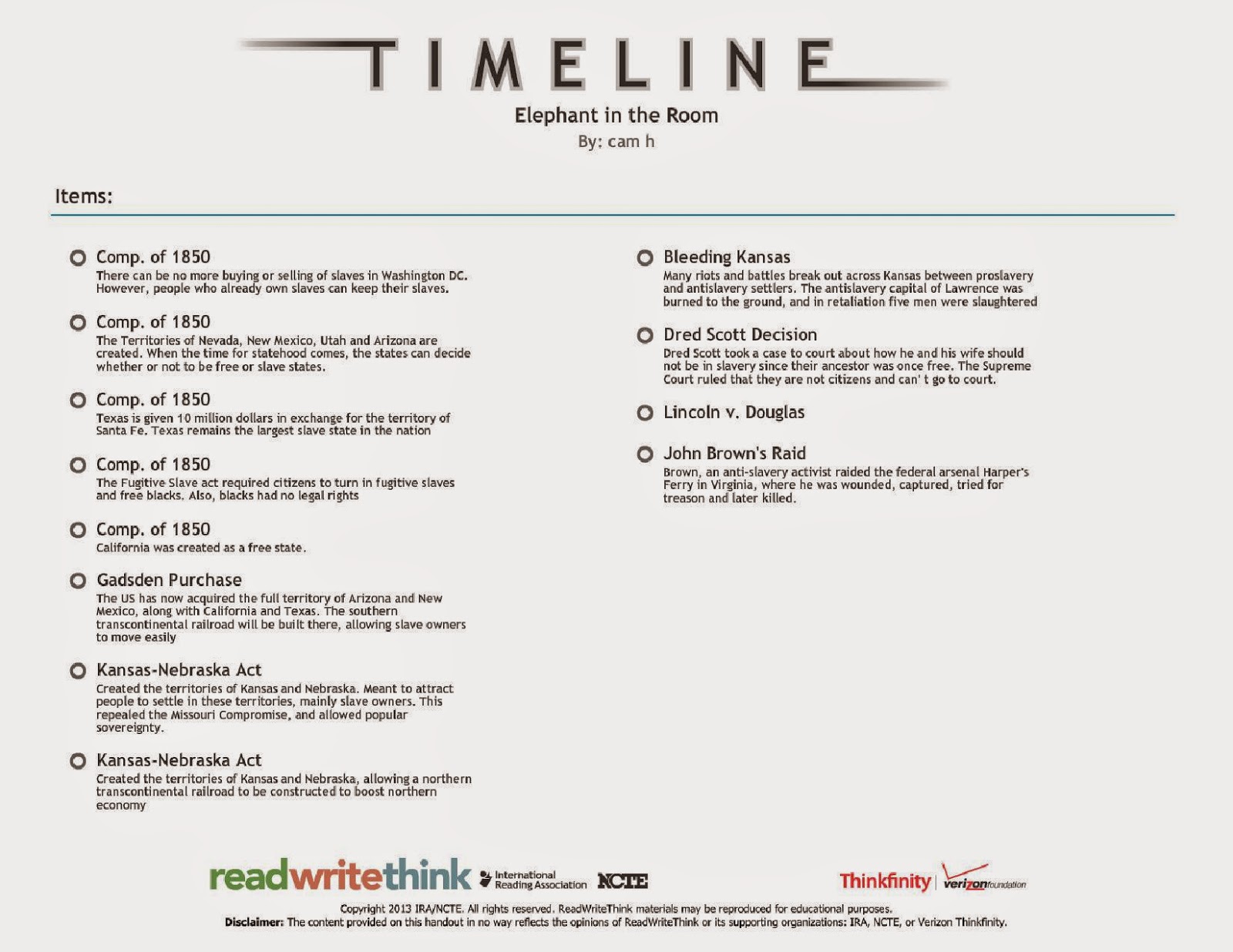
 How do we know the debate over slavery was the "elephant in the room" for American politics in the early 19th century? To answer this question we created timelines after reading about the major events that lead up to the Civil War. We then divided the events that were more pro-slavery (South) and more anti-slavery (North). The pro-slavery events are on the lower half of the line, and the anti-slavery events are on the upper half of the timeline. After reviewing these events, it is clear to see that American politicians were trying to pretend that slavery was not a problem, even though it clearly was based on the events that took place leading up to the Civil War. Thus, slavery became the "elephant in the room" all over America.
 By analyzing the events taking place, it can be seen that the tension between the North and South over slavery increases as the start of the Civil War approaches. For instance, the Gadsden Purchase in 1853, which mainly benefited the South because it opened up a new railroad in the area allowing slave owners to move more easily, created a new way for slave owners to expand their industry.
 Another Major event that happened was Bleeding Kansas. After the territory of Kansas had been allowed to chose whether to be a free or slave state by popular sovereignty, settlers from both the north and south rushed into the new land by the thousands. Naturally, fighting broke out between the two sides, and a number of people were killed. The northern capital that was established was burned to the ground, and in response, John Brown and a group of others took five southern men from their beds and massacred them in front of their families.
 A very large court event that became known as the Dred Scott Decision took place in 1857. Dred Scott and his wife sued a slave owner who tried to take them into slavery, saying that since they had come from free ancestors, they should not go into slavery. This case went to the Supreme Court, and in their verdict, they stated, "On the contrary, they were at that time considered as a subordinate and inferior class of beings, who had been subjugated by the dominant race, and, whether emancipated or not, yet remained subject to their authority, and had no rights or privileges but such as those who held the power and the Government might choose to grant them. The court think the affirmative of these propositions cannot be maintained. And if it cannot, [Dred Scott] could not be a citizen of the State of Missouri, within the meaning of the Constitution of the United States, and, consequently, was not entitled to sue in its courts." The court issued that since Scott cannot legally be a citizen of the US, he cannot have the right to sue in court. This was a very controversial verdict, and further increased the tension between the North and the South.
 Right before the start of the Civil Was, John Brown, the same who massacred the southern men in Bleeding Kansas, gathered a group of abolitionists and free blacks and attacked the federal arsenal at Harper's Ferry, hoping to get weapons to instigate a rebellion of slaves. Instead, Brown and his men were captured and tried for treason, then later killed. Brown was seen as a martyr in the North, and a murderer in the South. This caused the issue of slavery to fully become the elephant in the room for American Politics, and eventually led to the bombing of Fort Sumter and the beginning of the Civil War.

Tuesday, March 17, 2015

Antebellum Slavery

In 19th century America, a major part of society was the presence of slavery. Slaves were the ones who worked the plantations in the south, and did most of the other labor. The economic, social, and political power was mainly controlled by those who owned 20 or more slaves. This was because cotton was becoming a major export of the southern US, especially after the invention of the cotton gin, which increased cotton production. The more cotton that was being produced, the more slaves that were needed. This led to more cotton being produced, which made more money, which allowed for more slaves. This cycle eventually led to slavery becoming economically entrenched in American society. There is an interesting website with graphs showing how as cotton growth expanded in the south, the number of slaves did as well.
Link: http://mappinghistory.uoregon.edu/english/US/US18-01.html
A system that becomes so dependent on slavery for not only its economic power, but its social structure greatly affects human dignity. The government begins to classify the slaves by only the color of their skin, and not their skills or intelligence. This has been the way in America ever since Columbus landed in the Caribbean in 1492, he immediately enslaved the native peoples because of their race. The Americas have always been a land where one race thinks that they are better than the other, while overlooking their personal/physical traits.
Human dignity ultimately becomes corrupted by a system such as this. One example of this corruption is even written in the US Constitution, in Article 1, Section 2, Clause 3, where it reads "Representatives and direct Taxes shall be apportioned among the several States which may be included in the Union, according to their respective Numbers, which shall be determined by adding to the Number of free Persons, including those bound to Service for a Term of Years, and excluding Indians not taxed, three fifths of all other Persons." This eventually became know as the "Three-fifths rule" where blacks only counted as three fifths of a person when filing taxes and the number of Representatives in Congress. This showed that the government only classified the slaves based upon their race, and did not give them rights whatsoever.

Picture: http://www.democraticunderground.com/discuss/duboard.php?az=view_all&address=389x9294424

Tuesday, February 3, 2015

The Fight for Equality

In class we have been discussing the fight for women's rights in the 19th century. Many steps were taken to achieve this great feat, especially with the great amount of opposition that faced the reformers. Many felt that they were going against common practices in society. Practices that women wanted to reform can be seen in the document that they created for their movement, called the "Declaration of Rights and Sentiments", a parody on the Declaration of Independence. This document was presented in July of 1848 at the first ever convention for women's rights at Seneca Falls. In July 1848, over 300 men and women gathered at Seneca Falls, New York for the first women’s rights convention. This convention was held to abolish laws against women, such as divorce rights, the law stating women cannot own property, the right to vote, the right to equal pay, and the right to raise their children should the father die.

People at the time of the event had very diverse opinions on the matter. Most men did not wish for women to fight for equality, although there were some that supported the movement. In one newspaper article reporting on the event, the Oneida Wing, it states, "If our ladies will insist on voting and legislating, where, gentlemen, will be our dinners and our elbows? Where our domestic firesides and the holes in our stockings?" and that the convention was "the most shocking incident ever recorded in the history of womanity." In another report in The Recorder, it states, "We need not say we think the movement excessively silly." Although many were opposed to the movement, there were those who did support the fight for equal rights. In The National Reformer, it says "Lucretia Mott delivered one of the most eloquent, logical, and philosophical discourses we have ever listened to." So while many discarded the movement and did not care for it, there were those who did support it and push for equality in the mid 19th century.

Newspaper Reactions to Seneca Falls: http://www.loc.gov/exhibits/treasures/trr040.html

Thanks to the efforts of the reformers, the movement for equal rights between genders succeeded. Women gained voting rights, a right to property and equal pay, as well as more respect. However, men and women still have differences in rights between the two genders in modern society that could be improved. Usually, women are expected to uphold their looks and look good to men rather than be more headstrong and independent. The differences on how society depicts a man and a woman are shown perfectly in a Pantene commercial aired in the Philippines. This commercial shows a man and a woman in the same position, and how society will depict them.


We have most certainly made progress in gender rights since the mid 19th century. However, while men and women have equal rights in a legal sense, there are still many gender stereotypes floating around. Women are more often than not judged on their looks and appearance rather than their personality and integrity. We have come a long way, but there is still more we can do in ending gender stereotypes in modern times.

Tuesday, January 20, 2015

Insane Asylum

“…I shall be obliged to speak with great plainness, and to reveal many things revolting to the taste, and from which my woman’s nature shrinks with peculiar sensitiveness. But truth is the highest consideration. I tell what I have seen—painful and as shocking as the details often are—that from them you may feel more deeply the imperative obligation which lies upon you to prevent the possibility of a repetition or continuance of such outrages upon humanity. If I inflict pain upon you, and move you to horror, it is to acquaint you with suffering which you have the power to alleviate, and make you hasten to the relief of the victims of legalized barbarity…” —Dorothea Dix, Memorial to the Legislature of Massachusetts
In this Memorial to the Legislature of Massachusetts, the author, Dorothea Dix, holds a strong stance that the prisons need to be reformed. Dorothea Dix was the leading reformer of Massachusetts Prisons and insane asylums in the 19th century. She wanted prisons to be kept in better condition, and for the installment of insane asylums so that the mentally ill could be moved out of prisons. Naturally, she would hold a strong stance for this reform to be made in society. Dorothea wrote this document to try and convince the legislature to create insane asylums for the mentally ill. She prepared this paper to be read by the legislature and hear her opinion on the matter. In the 1800's, the mentally ill were not treated very kindly. Many beliefs and rumors affected their prison conditions. One rumor, for instance, was that the mentally ill could not feel heat or cold, so the prisons put the mentally ill in rooms without heat. They were chained to walls and were treated terribly. This document shows that Dorothea decided to do something about the awful conditions of not only the mentally ill, but prisons in general. She toured the state, examining many prisons and writing a report on each one's conditions. She compiled them into part of this memorial, and the conditions are somewhat patterned from prison to prison: handcuffs and chains, intentional beating, no heat. The writing can almost paint a picture in your head of what the prisons were like and how awful the conditions were. Dorothea claims that the prisons are so awful, that are "revolting to the taste". She states that the reports may "inflict pain upon you, and move you to horror". She is using the second person text to direct the reading towards the reader and make them feel more personal about these horrible conditions.
Source:
Dorothea Dix, “Memorial to the Legislature of Massachusetts
”University Park Press, 1843

Andrew Jackson: The People's President?

In class we learned about the 7th president of the United States, who has come to be known as "The People's President". But does this title really fit him? To figure this out, we divided into groups and chose a certain aspect of Jackson's presidency to research. My group was assigned the Spoils System. We created a Google slideshow to demonstrate our findings on the topic. Using the information we learned, we were able to come to a conclusion on whether Jackson was in fact a "People's President".

Andrew Jackson was the seventh president of the United States. Once he had taken office, many people realized he did not have many characteristics of a leader or a president, as he used to be a drunken gambler. But, he had been a great general in the War of 1812, so this made up for the prior. He is known for three events during his presidency: the Spoils System, the Bank War, and the Indian Removal Act or "The Trail of Tears". The Spoils System was a system devised during the Jacksonian Era, where a candidate would give government positions to his supporters as a reward for helping him win an election, and also as a motive to keep supporting him. As a result, 919 people who had government related jobs were fired to make room for Jackson's supporters. The U.S. Postal Service was hit the hardest, losing 423 postmasters to Jackson's system. The people were selected based on loyalty, rather than competence. There was a major incidence involving the system, where Samuel Swartwout, a man that Jackson had employed to be collector at a port, robbed the U.S. of over 1.2 million dollars. Another aspect of Jackson's presidency was the Bank War. Jackson vetoed the Bank Charter, thinking that the banks were corrupt and they would eradicate small-town businesses and huge companies would take over. This veto sent the economy into collapse, causing the Panic of 1837. The event that Jackson is most likely known for is The Indian Removal Act, where Jackson made several Indian Tribes move west to make room for the U.S. He was mainly answering to the white man's needs, and did not care about the Natives. He even made them march, and in the winter.

Andrew Jackson may have been considered a "People's President", but he only really served a handful of people with each of those aspects. He killed thousands of Indians, only to get more land. In the Bank War, he was trying to save the economy, but launched it into crisis. Also, he removed almost a thousand people from the government to make room for those who supported him. He was not a people's president, as the number of people he harmed far outweighed the number of people he helped.


Tuesday, January 13, 2015

The Rise of Democracy

Our Video Presentation

 The essential question was "How should we define democracy? How democratic was the United States in the early 1800s?" To answer this, my group created a video to try to explain the rise of democracy in the United States in the 19th century. We first analyzed the documents we were given: a painting and an article about it, two charts about the voting from the time period, voting quotes and a primary source about The Dorr War. By reading the documents and taking notes on each, we came up with the definition of democracy as: "Democracy is a form of government in which all legal citizens have the right to vote, and all votes have value." The votes may have direct or indirect impact. In the 1800's only white, male property owners were allowed to vote, not women or African Americans. Voting was not a structured process in the 19th century, as can be seen in the painting, where many of the men voting have already voted, but have sworn that they haven't already. Also, many candidates bought votes or won because certain judges liked them.

Monday, January 12, 2015

Latin American Revolutions

In class, we learned about the revolutions in Latin America. The revolutions of the Latin American countries of Mexico, Brazil, and Gran Columbia led to the abolishment of slavery in those countries, but also brought those countries closer to racial equality. These revolutions were a milestone in the quest to end slavery in many other nations across the globe, and set the motion in the anti-slavery movement. Without these revolutions and the people who contributed to them, slavery ending and racial equality may not have occurred. To further our knowledge on these events, we broke up into groups, each of us studying a different revolution. We read up on documents about the specific revolution, and then created timelines of the major events based on the reading. BY doing this, we not only learned the importance of these revolutions, but also the impacts of race and slavery on the New World colonies.
Our group was given the Gran Colombian Revolution. Here is a timeline of the major events:
  • April 19th, 1810: Simón Bolívar leads a conspiracy to take control of the Venezuelan government. 
  • July, 1811: National Assembly in Caracas declares Venezuela's independence. 
  • July, 1812: The Spanish regain control of the entire province. 
  • 1813: Bolívar returns to Venezuela and wins six successive engagements against the Spanish. On August 6, he enters Caracas and takes control. 
  • July, 1814: Bolívar loses control of Caracas again. Marches to Bogotá, recaptures the city from the Spanish.
  • 1817: Bolívar builds up an army
  • 1819: Bolívar has an army of 2,500 men. They cross flooded tributaries and mountains, losing a considerable amount of rebels.
  • August 7, 1819: Spanish surrender. 
  • December 17, 1819: Republica de Colombia is proclaimed 
  • June 21, 1821: Bolívar wins a battle at Carabobo
  • May 24, 1822: Bolívar's general wins a battle at Pinchincha
  • May, 1830: Bolívar resigns as leader of Colombia and retires to Europe. However, he reaches Santa Marta and dies of tuberculosis. 
The revolution, and the two others from that matter, originated mainly from racial inequality. The white Europeans put the African and indigenous slaves up against extremely harsh conditions, such as harvesting sugar cane. The sugar cane will cut the harvester very badly sometimes, and the workers would often be cut. But the Europeans did not care about this. All that mattered to them was that the natives were not white and that meant they were less than them. The Europeans had more advanced technology than the natives and slaves, so they did not think much of the threat of a revolt. However, they did not have numbers on their side. The native population made up 50% of total population of the colonies, and the slaves made up 11%. How much did the Europeans make up, do you think? 0.5%. This advantage in numbers was a major contributor to the success of the revolutions. The oppressed races in the areas, the natives and African slaves, fought for their independence and racial equality, as race was another major factor in the cause of the revolutions. All three of these revolts were fought to become independent from their European ruler, as well as to give rights to those who were enslaved or racially discriminated against. However, the revolutions did have their differences. One difference was that while the Colombian and Mexican revolutions involved fighting, the Brazilian revolution was non-violent. And, one important aspect of these revolutions is that racial inequality still remained problem.

Racial inequality is still a problem in modern times. Of course it is not as noticeable as it was during the Civil War period or the Civil Rights movement, but people are still racially profiled and discriminated against everyday. One recent example of this is the shooting in Ferguson, MO, where 18 year old Michael Brown, a black teenager, was shot by officer Darren Wilson, a white cop. This is an extremely controversial case, with protests sparking up all across the country. It is even moire so controversial that the officer was not convicted in his court case, a decision that was widely disliked among people across the country. Although this country has come a long way from its racist past, there is still racism in America, even though it is not nearly as prominent as it was in the past. We need to, as a community and as a country, work to overcome racism and discrimination, just as those in the Latin American Revolutions did.