In class this week, we learned about the westward advance, mostly focused on Buffalo Soldiers and the Native Americans they encountered. Tribes like the Cherokee and the Sioux had their homelands invaded by the American westward expansionists. The Buffalo soldiers were African American soldiers who had fought with the Union in the Civil War, and decided that being a soldier would be a better life than going back to the States, which were still very intolerant to blacks. Both the Buffalo Soldiers and the Tribes they encountered were discriminated by the United States Government, through racial classification. However, was the discrimination fully intentional?
The Buffalo soldiers were groups of black Civil War soldiers, who figured that being a soldier was better then returning to their old lives, due to the rise of sharecropping, a very unpopular method of work. This caused these soldiers to be deployed by the Government to go westward and clear the way for settlers to expand the United States borders. Clearing the way meant getting rid of Native American Tribes, through any means. The Buffalo Soldiers earned their name by clearing the midwest of the main source of food for the Native Americans: the buffalo. The soldiers cleared hundreds of thousands of buffalo from the Great Plains, reducing the population so greatly that the Native Americans greatest food supply was nearly exterminated. However, as much as the Buffalo soldiers did for the Government by clearing the way for new expansion, they were still the subject of racial discrimination. White Buffalo Soldiers still thought that they were above the blacks, and treated the black soldiers as inferior, even though they did the exact same job.
The Native Americans, on the other hand, were very racially discriminated. The US Government, through the buffalo soldiers, rid the Native Americans of the food source, their human rights, and their land. Native American tribes were exiled to lands far away from the Great Plains. Resistance did come from the tribes, but it was often crushed by the Buffalo Soldiers. The United States government did not negotiate with the Native Americans, and ushered in the Indian Removal Act, which caused all Native Americans to live in reservations set up by the government. However, some of the Government intentions were good in their eyes. They wanted to give the Native Americans the opportunity to become civilized, albeit through removing their cultural identity. They put them in reservations and gave them new clothes, new education, and new lives. All of which were American "civilized" style. The Dawes act was passed by the Government, allowing the Native Americans to own their own land, as long as they became civilized by American standards. Children were given education, and schools were eventually set up for them.
Although the Government did provide some benefits to the Native Americans for doing what they wished, the United States government did use the Buffalo soldiers to tear the Native Americans from their homes and migrate them somewhere else. They removed their cultural identity and tried to make them into new people, who were normal by American standards. The fact that they gave them education and the right to own land does not make up for the act of romoving their culture and taking their homes.
Friday, June 19, 2015

Tuesday, June 9, 2015
Rockefeller and Carnegie
In the mid to late 1800s, John D. Rockefeller and Andrew Carnegie became two of the most successful men of their time. These two controlled the market in oil and steel, respectively, by gaining a monopoly over the market. In class, we spent the week watching videos on Rockefeller and Carnegie's lives and reading documents about them. We then split ourselves into groups and analyzed specific aspects of each mans life.
 One of the main questions asked was how monopolistic leaders, like Carnegie and Rockefeller, affected the lives of the common worker. Each man affected the men who worked for them both negatively and positively.The way they accumulated such large companies was through buying out their competitors, and if they did not comply they would run the companies out of business. As ruthless as this is, it got them to the top, dominating the economy of their product. Causing so many businesses to go out greatly affected the working force in a negative way: so many workers were unemployed. This caused Rockefeller and Carnegie to be called "Robber-barons", or very corrupt company officials that bribed and cheated their way to the top. This was supported in the fact that Rockefeller, for example, bought out all the competition. While there was no more competition, Standard Oil, Rockefeller's company, had nobody to try and compete with, thus bettering the economy. However, it did put many people out of work.
Andrew Carnegie also had a good and bad side when coming to public criticism. Like Rockefeller, he also had a monopoly, but his was over the steel industry. Carnegie was born in Scotland and immigrated to America. Here he became a very successful steel company owner. He made a huge profit of money from the business, but then came the famous Homestead Strike. When profits skyrocketed for Carnegie Steel, but workers were given just a puny salary increase. This lead to strikes and protests outside the mill. Carnegie traveled to Scotland on vacation, and ordered his partner Clay Frick to close the mill. Frick did not, and instead brought in strikebreakers and Pinkerton guards to protect the. This resulted in a bloody fight, and ultimately the Pennsylvania militia was sent in to lessen the conflict. While this negatively impacted Carnegie's reputation among the workers, he did give away over $300 million to various charities towards the end of his life.
While both men seemed at first glance greedy, power hungry businessmen who only wanted the money for themselves, but did do good things for workers and other various causes. However, the amount of donations given to outside causes outweighs the hate that was given towards the two, which may have also been caused by jealousy for their wealth.
While both men seemed at first glance greedy, power hungry businessmen who only wanted the money for themselves, but did do good things for workers and other various causes. However, the amount of donations given to outside causes outweighs the hate that was given towards the two, which may have also been caused by jealousy for their wealth.
Saturday, May 16, 2015
Battles of the Civil War
In class, we went on a scavenger hunt throughout the school to learn about several battles of the Civil War. The day before the actual hunt, each student chose a battle and were given some basic information about the battle: Name, location, date(s), victor, etc. We then went home and created a google doc with the information on it, and used bit.ly to create a QR code for the document and a URL. Everyone printed out a piece of paper with the battle name, URL and QR code and brought it to class the next day. As a class we put them in places all over the school and tried to find a scan each one, then copy down the information. After all the battles had been scanned, we looked at patterns involving the area of the battle, the victor, and why they won. Our teacher created a Padlet and we discussed our essential questions and their answers.
The Civil War spanned across much of the country, but it can easily be sorted into three theaters: East, West, and Naval. Each side had an advantage over the other in each theater. For instance, in the naval theater, the north's strong economy compared to the south combined with their already existing navy led to the a northern domination on the sea. In the eastern theater, the Confederates were the main victors. It was the Confederates use of terrain and positioning in many battles that gave them this advantage. When the two armies met at the battle of Cold Harbor, the Confederates used the forested area to hide their troops and ultimately ended up winning. It was until the Battle of Gettysburg that the Union started to achieve victory in the East. On the west, the Union won significantly more battles than the Confederates due to their strategy. It involved many sieges, such as Vicksburg, where the Union surrounded and bombarded the city until they surrendered. The Union was ultimately able to win the war with their Anaconda plan, but the Confederates almost made a punch into breaking the Union through their eastern domination.
Each theater of the war had very similar tactics used in each of their battles. In the west, the Union ended up surrounding their enemies until they surrendered. In the east, the Confederates beat their opponents to the battle location and set up fortifications, or out maneuvered the Union. Although, towards the end of the war after Gettysburg, the Union had the Confederates on the back-foot, using momentum from the Battle of Gettysburg.

http://www.loc.gov/exhibits/civil-war-in-america/april-1861-april-1862.html
Each theater of the war had very similar tactics used in each of their battles. In the west, the Union ended up surrounding their enemies until they surrendered. In the east, the Confederates beat their opponents to the battle location and set up fortifications, or out maneuvered the Union. Although, towards the end of the war after Gettysburg, the Union had the Confederates on the back-foot, using momentum from the Battle of Gettysburg.
http://www.loc.gov/exhibits/civil-war-in-america/april-1861-april-1862.html
Thursday, May 7, 2015
Freedom from above and below
 It is the middle of the Civil War, the War over slavery that divided the United States into two opposing sides. While the Confederate and Union soldiers are slugging it out on the battlefield, President Lincoln decides to make a choice that will greatly affect the course of the war. On January 1st, 1863, Abraham Lincoln issued the Emancipation Proclamation, freeing the slaves all over America. The south, naturally, refused to recognize Lincoln as their president and therefore was outraged that he would dare try to free slaves, which was a part of their way of life. This week in class, we first analyzed a drawing of Abraham Lincoln with a family of slaves, as he is freeing them. This is an example of freedom from above, where a higher authority, in this case the President, is granting freedom to the enslaved. We then wrote on the drawing what we thought each character would say, for example, Lincoln might say "You and your family are now free peoples of the United States" or something along those lines. We then looked at four Lincoln Documents and analyzed how his opinion changed on the goal of the war as it went on. We also watched a PBS video on slavery in the US.
We also learned about another way that freedom is gained, freedom from below. This is when the enslaved people, usually due to their advantage in numbers, gain freedom by themselves via protests or other means. To analyze this method, we looked at two documents, a letter and a picture. The letter is from a Union officer who explains that slaves who have abandoned their plantations are following the Union troops and making an issue. This is an attempt to get the attention of the government to turn to the issue of slavery, as the soldiers would be slowed down by the runaway slaves. In the picture, it is a depiction of the slaves who worked on Confederate President Jefferson Davis' plantation all leaving and going to a Union camp. These both are examples of freedom from below, as the slaves are trying to become free by their own means and taking action. But when the slaves were eventually freed, was it because of freedom from above or below?
In 1863, President Lincoln issued the Emancipation Proclamation, stating that all slaves in the United States were free. Up until this point, the Union was being defeated overall in the war. Lincoln knew he had to wait until they won a considerable victory in the war, otherwise it would make the Proclamation look like a final attempt at coming back into the war. Instead, it appeared as a new motivation for the Union when they turned the tide of the war. Since all slaves were free in the North, they were no longer fighting to keep the Union together, but to free the slaves everywhere. Now, since the South did not recognize Abraham Lincoln as their president, they did not recognize the Emancipation Proclamation, and would not free their slaves. In fact, they were outraged! How dare the North try to change their way of life. While this was happening, slaves everywhere had heard the news and began to leave plantations everywhere. This may have greatly influenced Lincoln's actions, as the complaints from Union officers eventually worked their way up to him. It wasn't until the battle of Gettysburg that President Lincoln said the famous speech, The Gettysburg Address, starting with the famous quote, "Fourscore and seven years ago our fathers brought forth on this continent a new nation, conceived in liberty and dedicated to the proposition that all men are created equal." This is often acknowledged as the moment when the slaves were freed and the war over. It may seem as though the slaves were entirely freed by Lincoln's actions, however the slaves did have a large role in harassing Union soldiers to bring Lincoln's attention to the issue of slavery and giving the war a new goal. When the slaves were freed, it was freedom from above and below.
Monday, April 6, 2015
Why did the North win?
How did the differences between the North and the South affect each sides strategy during the Civil War?
To analyze this question we created an infographic:
Created this infographic helped me personally understand the topic much better. I am a visual learner by nature and the charts and diagrams helped me put into perspective the advantages that each opposing side had. The first diagram shows the huge advantage that the North had in population: almost twice as many people. The second diagram shows that the South had a huge population of slaves and the North had almost none at all compared. The South would be able to better produce its exports and make money to sustain an army. However, the next chart shows three categories: Industrial Workers, Manufacturing Plants, and Railroad Mileage; all of which the North had a huge advantage in. This means that they would be able to produce more weaponry and supplies and get it to the front-line faster. The south, however, had a simpler strategy compared to the North. The South just had to defend its borders and keep their way of life from the Union invaders. The South also had the best leadership and morale. However, this was not enough compared to the North's enormous advantage in numbers, and once they blockaded the Confederates, the War was heavily in their favor, despite the advantages that the South had.
To analyze this question we created an infographic:
Created this infographic helped me personally understand the topic much better. I am a visual learner by nature and the charts and diagrams helped me put into perspective the advantages that each opposing side had. The first diagram shows the huge advantage that the North had in population: almost twice as many people. The second diagram shows that the South had a huge population of slaves and the North had almost none at all compared. The South would be able to better produce its exports and make money to sustain an army. However, the next chart shows three categories: Industrial Workers, Manufacturing Plants, and Railroad Mileage; all of which the North had a huge advantage in. This means that they would be able to produce more weaponry and supplies and get it to the front-line faster. The south, however, had a simpler strategy compared to the North. The South just had to defend its borders and keep their way of life from the Union invaders. The South also had the best leadership and morale. However, this was not enough compared to the North's enormous advantage in numbers, and once they blockaded the Confederates, the War was heavily in their favor, despite the advantages that the South had.
Elephant in the Room

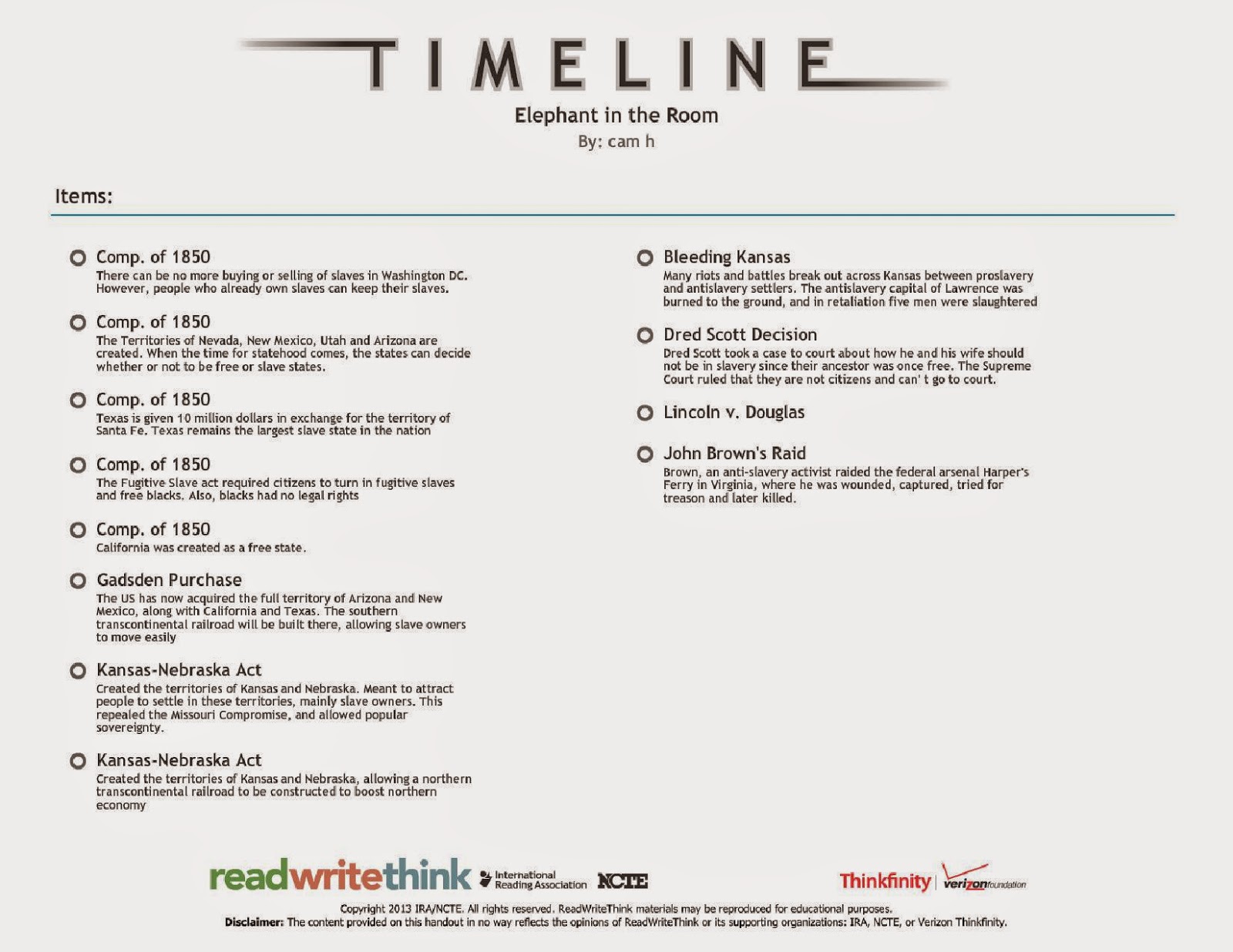 How do we know the debate over slavery was the "elephant in the room" for American politics in the early 19th century? To answer this question we created timelines after reading about the major events that lead up to the Civil War. We then divided the events that were more pro-slavery (South) and more anti-slavery (North). The pro-slavery events are on the lower half of the line, and the anti-slavery events are on the upper half of the timeline. After reviewing these events, it is clear to see that American politicians were trying to pretend that slavery was not a problem, even though it clearly was based on the events that took place leading up to the Civil War. Thus, slavery became the "elephant in the room" all over America.
By analyzing the events taking place, it can be seen that the tension between the North and South over slavery increases as the start of the Civil War approaches. For instance, the Gadsden Purchase in 1853, which mainly benefited the South because it opened up a new railroad in the area allowing slave owners to move more easily, created a new way for slave owners to expand their industry.
Another Major event that happened was Bleeding Kansas. After the territory of Kansas had been allowed to chose whether to be a free or slave state by popular sovereignty, settlers from both the north and south rushed into the new land by the thousands. Naturally, fighting broke out between the two sides, and a number of people were killed. The northern capital that was established was burned to the ground, and in response, John Brown and a group of others took five southern men from their beds and massacred them in front of their families.
A very large court event that became known as the Dred Scott Decision took place in 1857. Dred Scott and his wife sued a slave owner who tried to take them into slavery, saying that since they had come from free ancestors, they should not go into slavery. This case went to the Supreme Court, and in their verdict, they stated, "On the contrary, they were at that time considered as a subordinate and inferior class of beings, who had been subjugated by the dominant race, and, whether emancipated or not, yet remained subject to their authority, and had no rights or privileges but such as those who held the power and the Government might choose to grant them. The court think the affirmative of these propositions cannot be maintained. And if it cannot, [Dred Scott] could not be a citizen of the State of Missouri, within the meaning of the Constitution of the United States, and, consequently, was not entitled to sue in its courts." The court issued that since Scott cannot legally be a citizen of the US, he cannot have the right to sue in court. This was a very controversial verdict, and further increased the tension between the North and the South.
Right before the start of the Civil Was, John Brown, the same who massacred the southern men in Bleeding Kansas, gathered a group of abolitionists and free blacks and attacked the federal arsenal at Harper's Ferry, hoping to get weapons to instigate a rebellion of slaves. Instead, Brown and his men were captured and tried for treason, then later killed. Brown was seen as a martyr in the North, and a murderer in the South. This caused the issue of slavery to fully become the elephant in the room for American Politics, and eventually led to the bombing of Fort Sumter and the beginning of the Civil War.
Tuesday, March 17, 2015
Antebellum Slavery
In 19th century America, a major part of society was the presence of slavery. Slaves were the ones who worked the plantations in the south, and did most of the other labor. The economic, social, and political power was mainly controlled by those who owned 20 or more slaves. This was because cotton was becoming a major export of the southern US, especially after the invention of the cotton gin, which increased cotton production. The more cotton that was being produced, the more slaves that were needed. This led to more cotton being produced, which made more money, which allowed for more slaves. This cycle eventually led to slavery becoming economically entrenched in American society. There is an interesting website with graphs showing how as cotton growth expanded in the south, the number of slaves did as well.
Link: http://mappinghistory.uoregon.edu/english/US/US18-01.html
 A system that becomes so dependent on slavery for not only its economic power, but its social structure greatly affects human dignity. The government begins to classify the slaves by only the color of their skin, and not their skills or intelligence. This has been the way in America ever since Columbus landed in the Caribbean in 1492, he immediately enslaved the native peoples because of their race. The Americas have always been a land where one race thinks that they are better than the other, while overlooking their personal/physical traits.
Human dignity ultimately becomes corrupted by a system such as this. One example of this corruption is even written in the US Constitution, in Article 1, Section 2, Clause 3, where it reads "Representatives and direct Taxes shall be apportioned among the several States which may be included in the Union, according to their respective Numbers, which shall be determined by adding to the Number of free Persons, including those bound to Service for a Term of Years, and excluding Indians not taxed, three fifths of all other Persons." This eventually became know as the "Three-fifths rule" where blacks only counted as three fifths of a person when filing taxes and the number of Representatives in Congress. This showed that the government only classified the slaves based upon their race, and did not give them rights whatsoever.
Picture: http://www.democraticunderground.com/discuss/duboard.php?az=view_all&address=389x9294424
Link: http://mappinghistory.uoregon.edu/english/US/US18-01.html
 A system that becomes so dependent on slavery for not only its economic power, but its social structure greatly affects human dignity. The government begins to classify the slaves by only the color of their skin, and not their skills or intelligence. This has been the way in America ever since Columbus landed in the Caribbean in 1492, he immediately enslaved the native peoples because of their race. The Americas have always been a land where one race thinks that they are better than the other, while overlooking their personal/physical traits.
Human dignity ultimately becomes corrupted by a system such as this. One example of this corruption is even written in the US Constitution, in Article 1, Section 2, Clause 3, where it reads "Representatives and direct Taxes shall be apportioned among the several States which may be included in the Union, according to their respective Numbers, which shall be determined by adding to the Number of free Persons, including those bound to Service for a Term of Years, and excluding Indians not taxed, three fifths of all other Persons." This eventually became know as the "Three-fifths rule" where blacks only counted as three fifths of a person when filing taxes and the number of Representatives in Congress. This showed that the government only classified the slaves based upon their race, and did not give them rights whatsoever.
Picture: http://www.democraticunderground.com/discuss/duboard.php?az=view_all&address=389x9294424
Tuesday, February 3, 2015
The Fight for Equality
In class we have been discussing the fight for women's rights in the 19th century. Many steps were taken to achieve this great feat, especially with the great amount of opposition that faced the reformers. Many felt that they were going against common practices in society. Practices that women wanted to reform can be seen in the document that they created for their movement, called the "Declaration of Rights and Sentiments", a parody on the Declaration of Independence. This document was presented in July of 1848 at the first ever convention for women's rights at Seneca Falls. In July 1848, over 300 men and women gathered at Seneca Falls, New York for the first women’s rights convention. This convention was held to abolish laws against women, such as divorce rights, the law stating women cannot own property, the right to vote, the right to equal pay, and the right to raise their children should the father die.
People at the time of the event had very diverse opinions on the matter. Most men did not wish for women to fight for equality, although there were some that supported the movement. In one newspaper article reporting on the event, the Oneida Wing, it states, "If our ladies will insist on voting and legislating, where, gentlemen, will be our dinners and our elbows? Where our domestic firesides and the holes in our stockings?" and that the convention was "the most shocking incident ever recorded in the history of womanity." In another report in The Recorder, it states, "We need not say we think the movement excessively silly." Although many were opposed to the movement, there were those who did support the fight for equal rights. In The National Reformer, it says "Lucretia Mott delivered one of the most eloquent, logical, and philosophical discourses we have ever listened to." So while many discarded the movement and did not care for it, there were those who did support it and push for equality in the mid 19th century.
Newspaper Reactions to Seneca Falls: http://www.loc.gov/exhibits/treasures/trr040.html
Thanks to the efforts of the reformers, the movement for equal rights between genders succeeded. Women gained voting rights, a right to property and equal pay, as well as more respect. However, men and women still have differences in rights between the two genders in modern society that could be improved. Usually, women are expected to uphold their looks and look good to men rather than be more headstrong and independent. The differences on how society depicts a man and a woman are shown perfectly in a Pantene commercial aired in the Philippines. This commercial shows a man and a woman in the same position, and how society will depict them.
We have most certainly made progress in gender rights since the mid 19th century. However, while men and women have equal rights in a legal sense, there are still many gender stereotypes floating around. Women are more often than not judged on their looks and appearance rather than their personality and integrity. We have come a long way, but there is still more we can do in ending gender stereotypes in modern times.
People at the time of the event had very diverse opinions on the matter. Most men did not wish for women to fight for equality, although there were some that supported the movement. In one newspaper article reporting on the event, the Oneida Wing, it states, "If our ladies will insist on voting and legislating, where, gentlemen, will be our dinners and our elbows? Where our domestic firesides and the holes in our stockings?" and that the convention was "the most shocking incident ever recorded in the history of womanity." In another report in The Recorder, it states, "We need not say we think the movement excessively silly." Although many were opposed to the movement, there were those who did support the fight for equal rights. In The National Reformer, it says "Lucretia Mott delivered one of the most eloquent, logical, and philosophical discourses we have ever listened to." So while many discarded the movement and did not care for it, there were those who did support it and push for equality in the mid 19th century.
Newspaper Reactions to Seneca Falls: http://www.loc.gov/exhibits/treasures/trr040.html
Thanks to the efforts of the reformers, the movement for equal rights between genders succeeded. Women gained voting rights, a right to property and equal pay, as well as more respect. However, men and women still have differences in rights between the two genders in modern society that could be improved. Usually, women are expected to uphold their looks and look good to men rather than be more headstrong and independent. The differences on how society depicts a man and a woman are shown perfectly in a Pantene commercial aired in the Philippines. This commercial shows a man and a woman in the same position, and how society will depict them.
We have most certainly made progress in gender rights since the mid 19th century. However, while men and women have equal rights in a legal sense, there are still many gender stereotypes floating around. Women are more often than not judged on their looks and appearance rather than their personality and integrity. We have come a long way, but there is still more we can do in ending gender stereotypes in modern times.
Tuesday, January 20, 2015
Insane Asylum
“…I shall be obliged to speak with great plainness, and to reveal many things revolting to the taste, and from which my woman’s nature shrinks with peculiar sensitiveness. But truth is the highest consideration. I tell what I have seen—painful and as shocking as the details often are—that from them you may feel more deeply the imperative obligation which lies upon you to prevent the possibility of a repetition or continuance of such outrages upon humanity. If I inflict pain upon you, and move you to horror, it is to acquaint you with suffering which you have the power to alleviate, and make you hasten to the relief of the victims of legalized barbarity…” —Dorothea Dix, Memorial to the Legislature of Massachusetts
In this Memorial to the Legislature of Massachusetts, the author, Dorothea Dix, holds a strong stance that the prisons need to be reformed. Dorothea Dix was the leading reformer of Massachusetts Prisons and insane asylums in the 19th century. She wanted prisons to be kept in better condition, and for the installment of insane asylums so that the mentally ill could be moved out of prisons. Naturally, she would hold a strong stance for this reform to be made in society. Dorothea wrote this document to try and convince the legislature to create insane asylums for the mentally ill. She prepared this paper to be read by the legislature and hear her opinion on the matter. In the 1800's, the mentally ill were not treated very kindly. Many beliefs and rumors affected their prison conditions. One rumor, for instance, was that the mentally ill could not feel heat or cold, so the prisons put the mentally ill in rooms without heat. They were chained to walls and were treated terribly. This document shows that Dorothea decided to do something about the awful conditions of not only the mentally ill, but prisons in general. She toured the state, examining many prisons and writing a report on each one's conditions. She compiled them into part of this memorial, and the conditions are somewhat patterned from prison to prison: handcuffs and chains, intentional beating, no heat. The writing can almost paint a picture in your head of what the prisons were like and how awful the conditions were. Dorothea claims that the prisons are so awful, that are "revolting to the taste". She states that the reports may "inflict pain upon you, and move you to horror". She is using the second person text to direct the reading towards the reader and make them feel more personal about these horrible conditions.
Source:
Dorothea Dix, “Memorial to the Legislature of Massachusetts”University Park Press, 1843
In this Memorial to the Legislature of Massachusetts, the author, Dorothea Dix, holds a strong stance that the prisons need to be reformed. Dorothea Dix was the leading reformer of Massachusetts Prisons and insane asylums in the 19th century. She wanted prisons to be kept in better condition, and for the installment of insane asylums so that the mentally ill could be moved out of prisons. Naturally, she would hold a strong stance for this reform to be made in society. Dorothea wrote this document to try and convince the legislature to create insane asylums for the mentally ill. She prepared this paper to be read by the legislature and hear her opinion on the matter. In the 1800's, the mentally ill were not treated very kindly. Many beliefs and rumors affected their prison conditions. One rumor, for instance, was that the mentally ill could not feel heat or cold, so the prisons put the mentally ill in rooms without heat. They were chained to walls and were treated terribly. This document shows that Dorothea decided to do something about the awful conditions of not only the mentally ill, but prisons in general. She toured the state, examining many prisons and writing a report on each one's conditions. She compiled them into part of this memorial, and the conditions are somewhat patterned from prison to prison: handcuffs and chains, intentional beating, no heat. The writing can almost paint a picture in your head of what the prisons were like and how awful the conditions were. Dorothea claims that the prisons are so awful, that are "revolting to the taste". She states that the reports may "inflict pain upon you, and move you to horror". She is using the second person text to direct the reading towards the reader and make them feel more personal about these horrible conditions.
Source:
Dorothea Dix, “Memorial to the Legislature of Massachusetts”University Park Press, 1843
Andrew Jackson: The People's President?
In class we learned about the 7th president of the United States, who has come to be known as "The People's President". But does this title really fit him? To figure this out, we divided into groups and chose a certain aspect of Jackson's presidency to research. My group was assigned the Spoils System. We created a Google slideshow to demonstrate our findings on the topic. Using the information we learned, we were able to come to a conclusion on whether Jackson was in fact a "People's President".
Andrew Jackson was the seventh president of the United States. Once he had taken office, many people realized he did not have many characteristics of a leader or a president, as he used to be a drunken gambler. But, he had been a great general in the War of 1812, so this made up for the prior. He is known for three events during his presidency: the Spoils System, the Bank War, and the Indian Removal Act or "The Trail of Tears". The Spoils System was a system devised during the Jacksonian Era, where a candidate would give government positions to his supporters as a reward for helping him win an election, and also as a motive to keep supporting him. As a result, 919 people who had government related jobs were fired to make room for Jackson's supporters. The U.S. Postal Service was hit the hardest, losing 423 postmasters to Jackson's system. The people were selected based on loyalty, rather than competence. There was a major incidence involving the system, where Samuel Swartwout, a man that Jackson had employed to be collector at a port, robbed the U.S. of over 1.2 million dollars. Another aspect of Jackson's presidency was the Bank War. Jackson vetoed the Bank Charter, thinking that the banks were corrupt and they would eradicate small-town businesses and huge companies would take over. This veto sent the economy into collapse, causing the Panic of 1837. The event that Jackson is most likely known for is The Indian Removal Act, where Jackson made several Indian Tribes move west to make room for the U.S. He was mainly answering to the white man's needs, and did not care about the Natives. He even made them march, and in the winter.
Andrew Jackson may have been considered a "People's President", but he only really served a handful of people with each of those aspects. He killed thousands of Indians, only to get more land. In the Bank War, he was trying to save the economy, but launched it into crisis. Also, he removed almost a thousand people from the government to make room for those who supported him. He was not a people's president, as the number of people he harmed far outweighed the number of people he helped.
Andrew Jackson was the seventh president of the United States. Once he had taken office, many people realized he did not have many characteristics of a leader or a president, as he used to be a drunken gambler. But, he had been a great general in the War of 1812, so this made up for the prior. He is known for three events during his presidency: the Spoils System, the Bank War, and the Indian Removal Act or "The Trail of Tears". The Spoils System was a system devised during the Jacksonian Era, where a candidate would give government positions to his supporters as a reward for helping him win an election, and also as a motive to keep supporting him. As a result, 919 people who had government related jobs were fired to make room for Jackson's supporters. The U.S. Postal Service was hit the hardest, losing 423 postmasters to Jackson's system. The people were selected based on loyalty, rather than competence. There was a major incidence involving the system, where Samuel Swartwout, a man that Jackson had employed to be collector at a port, robbed the U.S. of over 1.2 million dollars. Another aspect of Jackson's presidency was the Bank War. Jackson vetoed the Bank Charter, thinking that the banks were corrupt and they would eradicate small-town businesses and huge companies would take over. This veto sent the economy into collapse, causing the Panic of 1837. The event that Jackson is most likely known for is The Indian Removal Act, where Jackson made several Indian Tribes move west to make room for the U.S. He was mainly answering to the white man's needs, and did not care about the Natives. He even made them march, and in the winter.
Andrew Jackson may have been considered a "People's President", but he only really served a handful of people with each of those aspects. He killed thousands of Indians, only to get more land. In the Bank War, he was trying to save the economy, but launched it into crisis. Also, he removed almost a thousand people from the government to make room for those who supported him. He was not a people's president, as the number of people he harmed far outweighed the number of people he helped.
Tuesday, January 13, 2015
The Rise of Democracy
Our Video Presentation
The essential question was "How should we define democracy? How democratic was the United States in the early 1800s?" To answer this, my group created a video to try to explain the rise of democracy in the United States in the 19th century. We first analyzed the documents we were given: a painting and an article about it, two charts about the voting from the time period, voting quotes and a primary source about The Dorr War. By reading the documents and taking notes on each, we came up with the definition of democracy as: "Democracy is a form of government in which all legal citizens have the right to vote, and all votes have value." The votes may have direct or indirect impact. In the 1800's only white, male property owners were allowed to vote, not women or African Americans. Voting was not a structured process in the 19th century, as can be seen in the painting, where many of the men voting have already voted, but have sworn that they haven't already. Also, many candidates bought votes or won because certain judges liked them.

The essential question was "How should we define democracy? How democratic was the United States in the early 1800s?" To answer this, my group created a video to try to explain the rise of democracy in the United States in the 19th century. We first analyzed the documents we were given: a painting and an article about it, two charts about the voting from the time period, voting quotes and a primary source about The Dorr War. By reading the documents and taking notes on each, we came up with the definition of democracy as: "Democracy is a form of government in which all legal citizens have the right to vote, and all votes have value." The votes may have direct or indirect impact. In the 1800's only white, male property owners were allowed to vote, not women or African Americans. Voting was not a structured process in the 19th century, as can be seen in the painting, where many of the men voting have already voted, but have sworn that they haven't already. Also, many candidates bought votes or won because certain judges liked them.
Monday, January 12, 2015
Latin American Revolutions
In class, we learned about the revolutions in Latin America. The revolutions of the Latin American countries of Mexico, Brazil, and Gran Columbia led to the abolishment of slavery in those countries, but also brought those countries closer to racial equality. These revolutions were a milestone in the quest to end slavery in many other nations across the globe, and set the motion in the anti-slavery movement. Without these revolutions and the people who contributed to them, slavery ending and racial equality may not have occurred. To further our knowledge on these events, we broke up into groups, each of us studying a different revolution. We read up on documents about the specific revolution, and then created timelines of the major events based on the reading. BY doing this, we not only learned the importance of these revolutions, but also the impacts of race and slavery on the New World colonies.
Our group was given the Gran Colombian Revolution. Here is a timeline of the major events:
Racial inequality is still a problem in modern times. Of course it is not as noticeable as it was during the Civil War period or the Civil Rights movement, but people are still racially profiled and discriminated against everyday. One recent example of this is the shooting in Ferguson, MO, where 18 year old Michael Brown, a black teenager, was shot by officer Darren Wilson, a white cop. This is an extremely controversial case, with protests sparking up all across the country. It is even moire so controversial that the officer was not convicted in his court case, a decision that was widely disliked among people across the country. Although this country has come a long way from its racist past, there is still racism in America, even though it is not nearly as prominent as it was in the past. We need to, as a community and as a country, work to overcome racism and discrimination, just as those in the Latin American Revolutions did.
Our group was given the Gran Colombian Revolution. Here is a timeline of the major events:
- April 19th, 1810: Simón Bolívar leads a conspiracy to take control of the Venezuelan government.
- July, 1811: National Assembly in Caracas declares Venezuela's independence.
- July, 1812: The Spanish regain control of the entire province.
- 1813: Bolívar returns to Venezuela and wins six successive engagements against the Spanish. On August 6, he enters Caracas and takes control.
- July, 1814: Bolívar loses control of Caracas again. Marches to Bogotá, recaptures the city from the Spanish.
- 1817: Bolívar builds up an army
- 1819: Bolívar has an army of 2,500 men. They cross flooded tributaries and mountains, losing a considerable amount of rebels.
- August 7, 1819: Spanish surrender.
- December 17, 1819: Republica de Colombia is proclaimed
- June 21, 1821: Bolívar wins a battle at Carabobo
- May 24, 1822: Bolívar's general wins a battle at Pinchincha
- May, 1830: Bolívar resigns as leader of Colombia and retires to Europe. However, he reaches Santa Marta and dies of tuberculosis.
Racial inequality is still a problem in modern times. Of course it is not as noticeable as it was during the Civil War period or the Civil Rights movement, but people are still racially profiled and discriminated against everyday. One recent example of this is the shooting in Ferguson, MO, where 18 year old Michael Brown, a black teenager, was shot by officer Darren Wilson, a white cop. This is an extremely controversial case, with protests sparking up all across the country. It is even moire so controversial that the officer was not convicted in his court case, a decision that was widely disliked among people across the country. Although this country has come a long way from its racist past, there is still racism in America, even though it is not nearly as prominent as it was in the past. We need to, as a community and as a country, work to overcome racism and discrimination, just as those in the Latin American Revolutions did.
Tuesday, December 9, 2014
Failed Revolutions
Were the revolutions of 1830 and 1848 really failures as many historians have concluded? This was the main question in our discussion on the revolutions throughout Europe in 1830 & 1848. They were all sparked by the French Revolution, and as Klemens von Metternich once said, "When France sneezes, Europe catches a cold" These revolutions are referred to as Decembrist, 1830 France, 1848 France, Frankfurt, and Hungary. The class broke into groups and we each analyzed the revolution that was given to us. After reading several primary sources and then creating a survey from the information, one group gave all the others a sheet with the information on it while they answered the survey. After all the groups had presented, we ranked each revolution on a scale from total failure to total success.
My group was given the revolution of 1848 France. The main events were during the months of February and June, when most of the action took place. The people were united against Louis Philippe's corrupt rule, and they desired to instate a French Republic. During the first fighting in February, thousands of citizens who had lost their jobs rose up in the streets and demanded a republic. There was not lots of conflict, however, as Alphonse de Lamartine described, "The people
were not numerous in the streets; they seemed to allow the invisible spirit of revolution to fight for them" (History of the Revolution of 1848 in France) Louis Philippe eventually stepped down from the throne, and the Second Republic was established. It was run mostly by the liberal, upper class of France. They also took away many jobs, and thus the working class revolted. There were many barricades built and lots of fighting this time, as said by Victor Hugo in Les Miserables, "Of what was the barricade made? Of the ruins of three six-story houses, torn down for the purpose, said some." However, this time the government crushed the revolt, and killed 1,500 people, and the Constitution for the Second Republic was written. The plan was for a legislature and a president, and Louis Napoleon was elected, as well as giving 9 million people the right to vote. In time, Louis Napoleon would get 90% of France to vote him as Empower, declaring himself Napoleon III. This led back to a monarchy, which was what the revolution was trying to get away from. Therefore, the revolution was technically a failure, but not completely.
Our survey: https://www.surveymonkey.com/s/VZLZM27
Contradictory to what many historians say, the revolutions of 1830 and 1848 were not all complete failures. For example, in 1830 France, they instated a new king that they wanted and suffrage was extended, albeit many people could still not vote. Also, in 1848 France, they essentially ended up back where they started, with a king even though they didn't want one. In Hungary, the rebels demanded an independent government and an end to serfdom. Many other areas of the Austrian Empire made similar demands as well. Originally, these demands were met, however Austrian forces soon defeated the rebels and took away their gains. None of these revolutions were successes, but they were neither the total failures that historians make them out to be.
My group was given the revolution of 1848 France. The main events were during the months of February and June, when most of the action took place. The people were united against Louis Philippe's corrupt rule, and they desired to instate a French Republic. During the first fighting in February, thousands of citizens who had lost their jobs rose up in the streets and demanded a republic. There was not lots of conflict, however, as Alphonse de Lamartine described, "The people
were not numerous in the streets; they seemed to allow the invisible spirit of revolution to fight for them" (History of the Revolution of 1848 in France) Louis Philippe eventually stepped down from the throne, and the Second Republic was established. It was run mostly by the liberal, upper class of France. They also took away many jobs, and thus the working class revolted. There were many barricades built and lots of fighting this time, as said by Victor Hugo in Les Miserables, "Of what was the barricade made? Of the ruins of three six-story houses, torn down for the purpose, said some." However, this time the government crushed the revolt, and killed 1,500 people, and the Constitution for the Second Republic was written. The plan was for a legislature and a president, and Louis Napoleon was elected, as well as giving 9 million people the right to vote. In time, Louis Napoleon would get 90% of France to vote him as Empower, declaring himself Napoleon III. This led back to a monarchy, which was what the revolution was trying to get away from. Therefore, the revolution was technically a failure, but not completely.
Our survey: https://www.surveymonkey.com/s/VZLZM27
Contradictory to what many historians say, the revolutions of 1830 and 1848 were not all complete failures. For example, in 1830 France, they instated a new king that they wanted and suffrage was extended, albeit many people could still not vote. Also, in 1848 France, they essentially ended up back where they started, with a king even though they didn't want one. In Hungary, the rebels demanded an independent government and an end to serfdom. Many other areas of the Austrian Empire made similar demands as well. Originally, these demands were met, however Austrian forces soon defeated the rebels and took away their gains. None of these revolutions were successes, but they were neither the total failures that historians make them out to be.
Thursday, December 4, 2014
The Congress of Vienna.
What should people in power do when their power is threatened? In class we tried to answer this question as we discussed the event that came during Napoleons conquest: The Congress of Vienna. This was held on September 1, 1814 as a meeting of representatives from all of the major powers of Europe. It was located in Vienna, Austria, and lasted until June 8, 1815. The leaders came to Vienna to discuss how to deal with Napoleon and how to fix Europe after he was gone. In class, we watched a video of actors playing Klemens von Metternich, Austria's Foreign Minister, while he goes to Napoleon who is asking for peace, while Metternich's demands are for Napoleon to give up his conquest and restore the old boundaries of Europe, or they will declare war. We then read an article about the Congress and the representatives that were present. They were all there because their power was threatened by Napoleon, who could potentially conquer them all.
When the major powers of Europe felt that their power was in danger, and that there was a risk of them all being conquered, they came up with a solution. Not just one, nut several, all applying to different problems that Napoleon had caused. One of these presented solutions was the Holy Alliance. This idea was initiated by Czar Alexander of Russia, and was a principle that stated that all monarchs of the major powers in Europe had divine right, or that their power as ruler came directly from God. This also meant that any revolution against the monarch was not only treason, but heresy for defying God's choice of ruler, leading to a more severe punishment. All of the major powers agreed with this, except for Britain who did not take part. This concept was used to lessen threats against their rule because nobody would rise up against the monarch, or they are technically rising up against God.
It is difficult to state whether the people at the Congress of Vienna made the correct choice when dealing with the many issues presented. However, with the situation of Napoleon conquering a large portion of Europe, these leaders made the correct choices that would protect their power. They even gave themselves more territory and authority, making it harder for them to lose their power to others. Their idea was to preserve the traditional monarchies of Europe, and to divide Europe into large, major countries that could withstand another invasion. Also, Napoleon was viewed as the enemy, and not France, so there was no severe punishment for the country or its people. There may have been a better solution, such as not combining smaller, minor countries into new ones or giving more rights to the people, but the only ones that had a say at the time were the powerful representatives of the nations. However, the powerful should be willing to sacrifice some of their power for the benefit of all, but the lower classes did not have say and therefore could not argue for equality.
When the major powers of Europe felt that their power was in danger, and that there was a risk of them all being conquered, they came up with a solution. Not just one, nut several, all applying to different problems that Napoleon had caused. One of these presented solutions was the Holy Alliance. This idea was initiated by Czar Alexander of Russia, and was a principle that stated that all monarchs of the major powers in Europe had divine right, or that their power as ruler came directly from God. This also meant that any revolution against the monarch was not only treason, but heresy for defying God's choice of ruler, leading to a more severe punishment. All of the major powers agreed with this, except for Britain who did not take part. This concept was used to lessen threats against their rule because nobody would rise up against the monarch, or they are technically rising up against God.
It is difficult to state whether the people at the Congress of Vienna made the correct choice when dealing with the many issues presented. However, with the situation of Napoleon conquering a large portion of Europe, these leaders made the correct choices that would protect their power. They even gave themselves more territory and authority, making it harder for them to lose their power to others. Their idea was to preserve the traditional monarchies of Europe, and to divide Europe into large, major countries that could withstand another invasion. Also, Napoleon was viewed as the enemy, and not France, so there was no severe punishment for the country or its people. There may have been a better solution, such as not combining smaller, minor countries into new ones or giving more rights to the people, but the only ones that had a say at the time were the powerful representatives of the nations. However, the powerful should be willing to sacrifice some of their power for the benefit of all, but the lower classes did not have say and therefore could not argue for equality.
Sunday, November 23, 2014
Ideologies
In class, we discussed the question: What were the major political ideologies of the 19th century and how did they influence social and political action? An ideology is defined as "A system of ideas or ideals, especially one that forms the basis of economic of political theory and policy" During the 19th century, there were three main ideologies. These were: Liberalism, Conservatism, and Nationalism. Liberalism is the ideology of wanting to benefit everybody, even if it means a little self sacrifice. Conservatism is about protecting the rights of each individual and preserving tradition. Nationalism is having pride in one's nation, and believing that each nation had a role to fill in history. We broke up into six groups, two for each ideology. We then studied our given ideology and created a presentation based on what we learned. After, the groups that had the same ideology presented their work and we decided which presentation had explained the ideology and its beliefs more thoroughly.
Our Presentation: https://www.educreations.com/
The group I had was given the ideology Nationalism. We created a presentation using Educreations and explained what Nationalism is, and also examples of Nationalism throughout history. One example we used was when Napoleon Bonaparte came to power and decided to invade Germany, which at the time was just a bunch of separate, small areas that shared culture and ethnics, they decided to band together, seeing their disunity as a weakness. This is an example of Nationalism, where areas with similar culture, history, beliefs, and ethnics become one nation.Nationalism also had effect on the social and political action in Europe at the time. Nationalists in Britain and France wanted strong, expansionist foreign policies, while Nationalists in smaller areas, like Germany and Italy, wanted national unification and to expel foreign rulers, such as Napoleon. This ideology created the country Germany from a cluster of small states that would on their own be vulnerable, but together would become a stronger force in Europe.
The other two ideologies were Liberalism and Conservatism. Liberals believed that "everyone" had God-given rights, and not just the aristocracy or monarch. However, these rights did not include women or the poor. They also supported lots of innovation and reform, stating that tradition would only hold people back. They also had effect on the political standpoint of Europe, campaigning for constitutional monarchies and wanting an end to Church privileges. These Liberals came from the middle class of Europe, wanting to cut the gap between them and the upper class. Conservatives, on the other hand, wanted to preserve tradition and live by it. They thought that since the traditions had worked for centuries, why would they want to abandon them, including traditional monarchies and aristocracies. They also hated revolutions, most notably the French Revolution, because they are bloody and cause chaos. They were from the upper, wealthier class of Europe, and wanted to preserve the rights that they had which the lower classes didn't.
Ideologies Article:
http://www.edline.net/files/_5KHVp_/699aa9d9c545a3533745a49013852ec4/Ideologies_Summaries_PDF.pdf
Our Presentation: https://www.educreations.com/
The group I had was given the ideology Nationalism. We created a presentation using Educreations and explained what Nationalism is, and also examples of Nationalism throughout history. One example we used was when Napoleon Bonaparte came to power and decided to invade Germany, which at the time was just a bunch of separate, small areas that shared culture and ethnics, they decided to band together, seeing their disunity as a weakness. This is an example of Nationalism, where areas with similar culture, history, beliefs, and ethnics become one nation.Nationalism also had effect on the social and political action in Europe at the time. Nationalists in Britain and France wanted strong, expansionist foreign policies, while Nationalists in smaller areas, like Germany and Italy, wanted national unification and to expel foreign rulers, such as Napoleon. This ideology created the country Germany from a cluster of small states that would on their own be vulnerable, but together would become a stronger force in Europe.
The other two ideologies were Liberalism and Conservatism. Liberals believed that "everyone" had God-given rights, and not just the aristocracy or monarch. However, these rights did not include women or the poor. They also supported lots of innovation and reform, stating that tradition would only hold people back. They also had effect on the political standpoint of Europe, campaigning for constitutional monarchies and wanting an end to Church privileges. These Liberals came from the middle class of Europe, wanting to cut the gap between them and the upper class. Conservatives, on the other hand, wanted to preserve tradition and live by it. They thought that since the traditions had worked for centuries, why would they want to abandon them, including traditional monarchies and aristocracies. They also hated revolutions, most notably the French Revolution, because they are bloody and cause chaos. They were from the upper, wealthier class of Europe, and wanted to preserve the rights that they had which the lower classes didn't.
Ideologies Article:
http://www.edline.net/files/_5KHVp_/699aa9d9c545a3533745a49013852ec4/Ideologies_Summaries_PDF.pdf
Friday, November 21, 2014
How Should We Remember Toussaint Louverture?
“Whatever defamation of character my enemies are spreading about me, I do not feel the need to justify myself toward them. While discretion obliges me to remain silent, my duty compels me to prevent them from doing any more harm.” (Toussaint Louverture). Toussaint Louverture was a person remembered for many traits. He was the leader of the 1791 Haitian Revolution, and also eventually became the ruler of Saint Domingue, the french colony now known as Haiti. He also led the slave army against the British and the French armies when they invaded the island. But what exactly should Toussaint be remembered for? His liberation of the slaves of Saint Domingue, his leadership as the ruler of the colony, or his role as a successful military commander? The most important aspect was that he was the liberator of the slaves, as shown in his role in the revolution.
Toussaint Louverture played a key role in the slave revolt. In 1791, he served as a doctor to the soldiers. (Doc A) He also commanded a small squad of slaves. He later became a well known commander and became the ruler of Saint Domingue. At this time, slavery was abolished in France and all of its colonies, including Saint Domingue. But, when Napoleon came to power, he wanted to reinstate slavery and sent over 21,000 soldiers to Saint Domingue. But, Toussaint fought for the slaves again and defeated the French, although he was captured and died in jail. Even though Toussaint did not live, he help Saint Domingue gain its independence and end slavery, and liberated all of the slaves.
After Toussaint had first liberated the slaves, he did not stop there. When the French Directory became the government of France, they were going to reinstate slavery in Saint Domingue. Toussaint would not let his people go back to being enslaved, so he wrote a letter to the French Directory. (Doc B) In it, he stated “Could men who have once enjoyed the benefits of liberty look on calmly while it was taken from them!” He is telling the French Directory that if they wish to put slavery back, the former slaves will not just allow it to happen. He later states that “We have known how to confront danger to our liberty, and we will know how to confront death to preserve it” As the liberator of the slaves, he is threatening the french not to put slavery back, or they will fight for their independence again.
After the slave revolt of 1791, Louverture had to set up new laws for the colony. In The Saint Domingue Constitution of 1801, it states, “There cannot exist slaves in this territory, servitude is therein forever abolished. All men are born, live and die free and French.” (Doc C) He is permanently abolishing slavery in Saint Domingue, and creating a free colony, but still under French rule. He is doing his role as the Liberator of slaves and officially freeing all people in Saint Domingue.
Although Toussaint Louverture possessed many traits, such as military leadership or skill in politics, he should mainly be remembered for liberating the slaves of Saint Domingue. He served in the army commanding the liberation army, threatened to fight the French again if they reinstated it, and officially abolished slavery in the colony. This shows that Louverture was a very important figure in liberating the slaves, and should be remembered for this feat among others.
Friday, October 31, 2014
Napoleon's Impact
Napoleon Bonaparte was the greatest general of his time. He conquered vast amounts of land in Europe and set up new reforms throughout the continent. But what exactly were Napoleon's impacts on the social, political, and economic systems of Europe?
Napoleon made many allies as well as enemies during his rule. One of his enemies was Madame de Stael, a member of the nobility. When Napoleon took over, she lost her social status, along with many other nobles. This made them extremely upset. Another person who was close to Napoleon was Marshall Michael Ney, an officer and one of Napoleon's most trusted generals. He say Napoleon as the legitimate dynasty of France and the sovereign to the country.
When Napoleon conquered Europe, he put in many new reforms. He controlled prices and made new industry, and sold Louisiana to the United States. He reworked the entire map of Europe. Napoleon stole vast amounts of artwork from other countries. Also, he abolished serfdom and ended special privileges of the Church. When he invaded Egypt, he changed the government and founded the Institute of Egypt, which studied their ancient history.
 http://en.wikipedia.org/wiki/Napoleon
Napoleon made many allies as well as enemies during his rule. One of his enemies was Madame de Stael, a member of the nobility. When Napoleon took over, she lost her social status, along with many other nobles. This made them extremely upset. Another person who was close to Napoleon was Marshall Michael Ney, an officer and one of Napoleon's most trusted generals. He say Napoleon as the legitimate dynasty of France and the sovereign to the country.
When Napoleon conquered Europe, he put in many new reforms. He controlled prices and made new industry, and sold Louisiana to the United States. He reworked the entire map of Europe. Napoleon stole vast amounts of artwork from other countries. Also, he abolished serfdom and ended special privileges of the Church. When he invaded Egypt, he changed the government and founded the Institute of Egypt, which studied their ancient history.
Thursday, October 23, 2014
A Bite of Communism
In a recent class activity, we learned about Capitalism, Socialism, and Communism by using an activity that involved Hershey's Kisses. Every student was given 2 pieces of chocolate, although 3 students were given 8 to begin with. Then, everyone got up and played rock-paper-scissors with another student. If you lost, you gave one piece to the person you played. If you won, they gave you a piece. Once you ran out of chocolate, you were out. The game stopped when there were about 5 people left who had all the remaining candy. This part was meant to represent Capitalism, where you take a gamble to try to make money, and you can make it big or get broke. The people who had no candy, meant to represent the poor, felt that it was unfair that only certain people had lots of candy. So, all of the candy was taken back, and everyone was evenly distributed the candy between everyone. This part was meant to represent when the poor would rise up against the rich and demand reform and money equality. This represents Socialism, where economic equality is achieved. We were then asked who would risk playing rock paper scissors again, and few people would. This means that in society, a classless society would be achieved, where nobody would risk trying to become rich because the poor would rise against them. They would agree to share all the resources, and since there is no government needed to regulate anything, this leads to Communism. This is Carl Marx's theory on Communism.
Marx's theory on how the poor would help themselves is, in breif, that the poor would eventually rise up against the rich to try and make things more fair. After econmic equality would be reached, people would not accept sharp economic divisions anymore. Thet would create a Communism. However, another man at the time named Adam Smith wrote The Wealth of Nations, a capitalist book. Smith is recognized as the father of Capitalism. He used the metaphor "The Invisible Hand" in his writing. His theory is that people would to become rich by working, and by doing this, the country would also benefit. The government would not be needed in the economic stage because the invisible hand would guide people. This is very different fron Marx's theory.
I personally believe that Smith's theory on the economy is better. It does not require a huge revolt after a long period of poverty, like Marx's does. Smith's plainly states that if you work hard, you will not only help yourself but you will help your country as well.
Marx's theory on how the poor would help themselves is, in breif, that the poor would eventually rise up against the rich to try and make things more fair. After econmic equality would be reached, people would not accept sharp economic divisions anymore. Thet would create a Communism. However, another man at the time named Adam Smith wrote The Wealth of Nations, a capitalist book. Smith is recognized as the father of Capitalism. He used the metaphor "The Invisible Hand" in his writing. His theory is that people would to become rich by working, and by doing this, the country would also benefit. The government would not be needed in the economic stage because the invisible hand would guide people. This is very different fron Marx's theory.
I personally believe that Smith's theory on the economy is better. It does not require a huge revolt after a long period of poverty, like Marx's does. Smith's plainly states that if you work hard, you will not only help yourself but you will help your country as well.
Thursday, October 9, 2014
The Lowell Experiment
America and England are in the midst of a new era of production and innovation. The industrial revolution has come to both countries, but there are many costs. The factories that have been set up have extremely poor working conditions. In both American and British factories, there was a very high risk of death. The machines could end up being fatal if you weren't paying attention, and there was one case where somebody was even chopped in half. There also wasn't very clean air to breathe, as dust particles and cloth bits floated throughout the air. In the factories, it was extremely easy for a disease to go around, since many people were working close together. The workers were young women, or children, so death was even more of a possibility.
Neither country had it much worse than the other, even though the English established their factories first, thus getting poor working conditions first. The factory owners wanted to maximize production, so they did not prioritize the healthy conditions. However, if a death occurred in a factory in America, it was much harder to replace that worker, since in England they had orphanages where they could just get new workers from. They did not have those in America, so they had to rely on farm girls to come to Lowell.
Neither country had it much worse than the other, even though the English established their factories first, thus getting poor working conditions first. The factory owners wanted to maximize production, so they did not prioritize the healthy conditions. However, if a death occurred in a factory in America, it was much harder to replace that worker, since in England they had orphanages where they could just get new workers from. They did not have those in America, so they had to rely on farm girls to come to Lowell.
Sunday, September 28, 2014
A Google Chat with MOSI
Last week, I was able to speak with the Museum of Science and Industry in Manchester, England via Google video chat. We spoke with Jamie, a museum curator, who showed us many of the industrial-era machines and described how they were used. To prepare for this, in class we did some looking around on the MOSI website to learn more about the machines they had. We also learned about some of the terms used in the mills, such as carding, slubbing, and roving. We then wrote down some questions that we wanted to ask Jamie in our notes for the chat.
During the chat, Jamie described to us the textile process in the mills. It was a very dangerous and unsanitary process, but there was no faster way of making cloth at the time. The wool was cleaned, straightened, combined into slivers of cloth, twisted, and finally weaved into usable cloth. The new inventions of machines helped this process. They made producing cloth faster and cheaper. One of these machines was the Arkwright Waterframe, which was a water powered machine that made producing cotton even faster. Another was the carding engine, which sorted and cleaned the fibers into strands that could then be made into cloth. These machines were faster, but dangerous. People could have legs broken, limbs lost, and even killed. One person was chopped in half by a machine.
Discussing the Industrial Revolution with an outside expert greatly widened my knowledge of this topic. I enjoyed speaking with Jamie about this topic. I think it would be fun to speak with him or another expert on topics throughout the year.
Here is a picture of Jamie from the MOSI:

During the chat, Jamie described to us the textile process in the mills. It was a very dangerous and unsanitary process, but there was no faster way of making cloth at the time. The wool was cleaned, straightened, combined into slivers of cloth, twisted, and finally weaved into usable cloth. The new inventions of machines helped this process. They made producing cloth faster and cheaper. One of these machines was the Arkwright Waterframe, which was a water powered machine that made producing cotton even faster. Another was the carding engine, which sorted and cleaned the fibers into strands that could then be made into cloth. These machines were faster, but dangerous. People could have legs broken, limbs lost, and even killed. One person was chopped in half by a machine.
Discussing the Industrial Revolution with an outside expert greatly widened my knowledge of this topic. I enjoyed speaking with Jamie about this topic. I think it would be fun to speak with him or another expert on topics throughout the year.
Here is a picture of Jamie from the MOSI:
Subscribe to:
Posts (Atom)